
The following information received today is very useful preparatory reading for my follow-up to The Four Faces of God and Unity. It appears courtesy of PROPHECY TodayUK (click for original).
Paul Luckraft reviews Steve Maltz’s ‘How the Church Lost The Way…And How it Can Find it Again’:
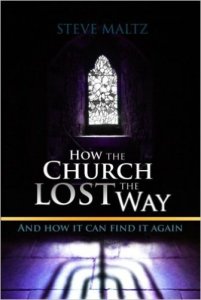 In this engaging and entertaining book, the author is very clear about his agenda: “to restore the understanding of the Hebraic roots of Christianity that has been lost, since the early days of the Church” (p 43). Equally clear is that in this book he has succeeded in making a considerable contribution towards what is an immense but vital task.
Maltz’s style is chatty, but not trite. He pulls no punches – he admits he may not just be upsetting the occasional sacred cow but disturbing the whole herd – but his aim is analysis, rather than attack. Certainly at every point he makes you think, and feel, and search for a proper response.
His title is apt in two ways, suggesting a straying from a correct path, but also reminding us that the early Christians were originally called The Way (Acts 9:2, 24:14), rather than the Church. Maltz points out that there has been a process of stripping out every trace of Jewishness from the established Church, starting early in its history and developing over time. The Body of Christ was meant to be One New Man (Eph 2:15) with both Jewish and Gentile elements in balance, and without this it is greatly diminished and largely unfulfilled.
How We Wandered
In Part One, the author tells ‘a tale of two summits’, taking us to two important councils: Jerusalem in AD 49 and Nicaea in AD 325. In an entertaining fly-on-the-wall (or rather peering-round-the-pillar) account, Maltz contrasts these two occasions, the former advocating the inclusion of Gentiles into the Church, the other the exclusion of Jews.
The most telling quote is from Constantine’s letter circulated to churches throughout the Christian world concerning the timing of Easter: “Let us then have nothing in common with the most hostile rabble of the Jews” (p48).
In chapter 2, Maltz provides a fascinating potted history of the main Greek thinkers: Socrates, Plato and Aristotle, highlighting their ‘big ideas’ and the equally big consequences of those ideas on Church history. He demonstrates how the early Church fathers reconstructed Christianity in Platonic terms, mixing the Bible with Platonic thinking.
As we are shown the long slide away from our Jewish roots into Greek dualism we are given excellent summaries – neither too long nor too short – of Philo (and allegory), Origen, Augustine, and Aquinas. In each case there is just enough detail to convince us that “the great doctrines of Christianity had become a philosopher’s playground” (p42).
This may only be an introduction to a very large topic, but the main point comes across clearly. The Church is “far more Greek in its outlook than people could ever imagine and this is not a side issue, but very much a key battleground for the truth” (p60).
Reclaiming Our Heritage
Part Two is largely comprised of a series of vignettes highlighting different aspects of the Hebraic worldview that we need to reclaim.
Maltz starts by looking at the Bible itself and how it should be interpreted from a Hebraic perspective, and then goes on to examine the Hebrew language, family life and marriage, the Sabbath and especially the Jewish festivals and calendar. This latter section is the longest and most informative. The Jewish biblical festivals are “so instructional, so rich in meaning, so bursting in Jesus, that it can do us nothing but good to be aware of them” (p106).
Part Three revisits the idea, mentioned earlier in the book, that the body of Christ is meant to be One New Man. Here is a fascinating discussion on what this should entail, namely a balance between the two distinctive elements of Jew and Gentile. Not a blurring into one but a partnership, and a preparation for heaven!
No Apology Needed
At one point towards the end the author seems to apologise that he has meandered all over the place (though he adds hopefully, not randomly). In fact, there is no sense of meandering as you read through this book. It can be taken as a whole, or in parts. Although there is no index, there is an appendix of recommended further reading, helpfully arranged to coincide with the chapters of this book.
It covers its main themes well, and also ends with a plea for each Christian believer to take personal responsibility to examine the Bible through the eyes and experiences of the early Jewish believers, rather than the contact lens of Greek philosophy. (Amen: emphasis RB)
If we all individually re-evaluate our image of God and attitude to worship and fellowship then, as the subtitle suggests, the Church can find The Way again.
 ‘How the Church Lost The Way’ (190 pp, paperback, £10) is the first of Steve Maltz’s three books on the state of the Western church which are available from Saffron Planet Publishing. His website is Saltshakers. (Update: see Comments re availability on Kindle.)
Steve’s work will be featured in Prophecy TodayUK over the next few weeks. For more about Steve on this blog see my introductory remarks about ‘God’s Signature’ in Holy Treasure of ‘The Open Door’ (reading from sub-heading ‘A Deep Insight From Hebrew’).
Although I haven’t yet read this book on the Church I’m sure it’s as easy, enjoyable reading as ‘God’s Signature’.
PS: see also Jeff Benner’s brief intro’ on errors in Bible translations, About the Ancient Hebrew Research Centre (thank you Nelson Walters at The Gospel in the End-Times).


 As I sat with the Lord today, He was highlighting ALIGNMENTS to me again. He was speaking to me about the SURPRISE ALIGNMENTS that are taking place right now in this season. There is a deep shifting and shaking of alignments taking place. In this “shifting and shaking” of alignment, the Lord is creating new bridges of connection and networking in the body of Christ. In this “SHIFTING AND SHAKING”, He is “MOVING AND SHAKING!”.
 We should note Malcolm’s reservations mirror those of Wigglesworth’s contemporaries over his unorthodox, questionable ministry methods – but whatever the Lord wanted to heal or expel got accomplished. (Bobby Conner recounts his astonishment at seeing a dubious church leader in Jesus’ presence but being rebuked because he’s the Lord’s servant!) Malcolm’s
  On Good Friday 2015 Charles Shamp taught on the coming September’s fourth blood-moon as marking the beginning of the time of the Army of God. He believes it starts a two-year period that’s open for all believers, but especially for a glorious company praying things from the Age to Come.
  Born in 1859, Smith Wigglesworth was an unschooled plumber by trade living in Bradford, England. In
  ‘When the new church phase is on the wane, there will be evidenced in the churches something that has not been seen before: a coming together of those with an emphasis on the Word and those with an emphasis on the Spirit.

 “The manifold wisdom of God is like a multi-faceted, multi-coloured gem.”

 Like snowflakes three more pieces of the ‘invisible jigsaw’ gently waft down, yet remain unsuspected. They’re noticed only when they settle and although single, sit side-by side as though fitting like pieces of a jigsaw puzzle.
 And NOW – actually whilst typing – I’m getting distinct ripples and chills down my neck as Heather Clark sings, “For the Lord our God He is holy…holy, holy, holy, holy, holy is the Lord God Almighty…” in her distinctive rendition of Exalt The Lord. (‘Glorious Praise’ cd.)



 Thank you to Mike Parsons for the first of two posts that will give my readers a base for what I’m about to blog on prophecy and time, as an outcome of weekend’s



 Richard's Watch
