Click above image to read report in full and Richard’s Watch on Telegram for:
 See earlier post for extract from prophetic word to Amanda Grace about this event!

Click above image to read report in full and Richard’s Watch on Telegram for:
See earlier post for extract from prophetic word to Amanda Grace about this event!

In his excellent above-titled summary published yesterday Texan Jack Dennis asks:

MORE NEWS(17th & !8th March) >


Almost a year ago, Joe Biden’s pick for CDC director appeared with MSNBC’s Rachel Maddow telling her first big lie: “Our data from the C.D.C. today suggests that vaccinated people do not carry the virus, don’t get sick. And that it’s not just in the clinical trials, it’s also in real-world data.” The following day, April 1, 2021, with pressure from Big Pharma and the White House, the CDC had to walk back their director’s comments. […continued at…] CDC Director Admitted Big Mistakes With Pandemic — Clever Journeys
In this posting author Jack Dennis, former private investigator and author with many awards and top-level interviews under his belt, enumerates mistakes the director for America’s Centre for Disease control has made and closes with this, to which a recent prophetic word alludes:
‘…Dr. Joe Mercola watched the speech and commented that much of Walensky’s “presentation is riddled with statements that likely revealed more than she intended. She might not have realized the presentation was being taped or thought a taped presentation in front of medical students wouldn’t be found. Or maybe, the CDC simply doesn’t care that what they say in 2022 is the same information that caused many to be censored or maligned in 2020 and 2021.”
Readers may recall a couple of previous incidents I’d noted (among many published by The Gateway Pundit):
Prophecy fulfilled on spoken ‘slips’ made by Biden regime
3 prophecies fulfilled in Biden’s State Of The Union slip-of-tongue
Here’s the relevant part of what the Lord gave Amanda Grace on 17th December last (underscoring added):
“And says the Lord of Hosts, the mouth of the one in a White House shall get tongue-tied and twisted as the Spirit of truth descends upon their stump. And they shall reveal the secrets and keys to a plan gone rogue, more lone wolves says the Lord, and they shall connect back. As the donkey so spoke truth to Balaam so the donkeys shall be kicking themselves as they lose control of their mouths at MY WORD and they shall make slips of the century, slips of the tongue that shall change some of the narratives, says the Lord of Hosts, truth serum shall be slipped as those who serve the constitution and this nation have become more and more EAGER to execute operations under the cuff, says the Lord of Hosts. And says the Spirit of the Lord. this day I am turning the pyramid on its head and as it is shaken the executives and engines and masterminds that have steered this agency shall cause a topsy-turvy to occur as I the Lord your God deal with the sorcerers and potion makers and creation-haters of the three-letter departments….”
Most readers will recall the vision Veronika West published on 16 January 2021 linked in image below (overwrites current screen), and my monitoring its fulfillment – NB: VIP, connection to WordPress keeps dropping so this musty be a Very Important Post!

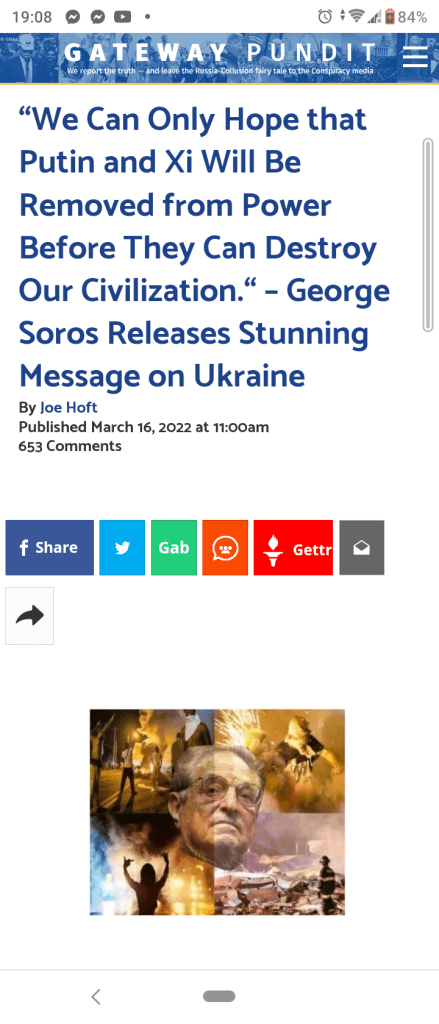
Maybe you’re already aware of this news from The Gateway Pundit indicating that prophecy is moving nearer to fulfillment…but note especially the latest opinion piece Continue reading
To enable this to get out after a late-afternoon of internet dropouts – even corrections failing – I’m limiting this posting to screenshots of news connecting the prophecies Veronika West brought into the ongoing Gog-Magog alliance of chapter 38 in prophet Ezekiel’s book.
A week or so ago I was taking so-called ‘friendly-fire’ from someone adamantly insistent this prophecy has been fulfilled, according to medieval historians – BUT IF that’s true, then how come modern scholars STILL say its eschatalogical? AND how come the specific modern-day nations of great military prowess are in an operational alliance??? SEE below, in reverse chronological order:
AND this doesn’t include modern rabbinic prophecies!!

RECAP: On 22 February I began Bible Update: Daniel 7 vision of bear eating 3 ribs – Veronika West’s vision of Russia-Ukraine as follows:
‘As soon as I saw the following image it reminded me of part of the mind-blowing vision of four beasts and ‘one like a Son of Man coming with the clouds of heaven’ that Old Testament prophet Daniel was given about 2,670 years ago, as recounted in chapter 7 of his book:

Ukraine and two areas claiming independence and Russia’s support look like three ribs, the largest as though being a chunk of meat. Read Daniel’s vision in full here, noting:
5 And suddenly another beast, a second, like a bear. It was raised up on one side, and had three ribs in its mouth between its teeth. And they said thus to it: ‘Arise, devour much flesh!’
This is usually regarded by scholars as relating to the ancient Medo-Persian empire but in view of the plainly eschatalogical interpretation Daniel was given, the direct reference Jesus Christ made to his writings, plus their later connection to the Revelation that God gave to Him and shared with His Apostle John, it is not wholly without merit to consider this beast’s imagery as relating to modern Russia – also symbolically known as a bear.’
A FIRST WITNESS
Next therein, I republished Veronika West’s word of 24 January The Bear Nation Arises With A Hunger For War! This includes an opening line “But listen, for The Lion of Judah will roar as the Great Eagles soar!” This seems like the British lion and America’s bald eagle, but the spiritual allusion makes it quite clear this is not our two nations.
On 3rd March she published Three Times the Bear Shall Bite in which begins, ‘Listen! For at the sound of the roar of The Lion. Nations shall be shaken and boundary lines shall be shifted, as battle-lines are being drawn. And then they will say, “Look! Look to the Nation of Germany!” For out of the dark cave of isolation and shame, it shall suddenly emerge from the shadows for greater political power and monetary gain.
Veronika then refers to Germany as a Leopard that “doesn’t change its spots” and then to a Red Dragon.
BUT, in checking Daniel 7 I was struck by the fact these four symbolical characters appear simultaneously! Verse 3 states, ‘And four great beasts came up from the sea, each different from the other.’ Note well; they appeared at the same time! Also, there’s nothing in the explanation-interpretation Daniel was given (verse 15 onwards) explicitly stating that those empires will be consecutive – it’s simply assumed!
[Scholars and theologians consider those four beasts of winged lion, lolling bear, four-headed and winged leopard plus a terrifying and unnatural griffin-like beast, out of which grows the infamous ‘little horn,’ represent four historical, consecutive empires that were to invade the Middle-East: viz, Babylon, Medo-Persia, Greece and Rome.]
In the second word Veronika relates ‘…And many will say, “See! A Leopard doesn’t change its spots.” For surely what will begin to unfold is a type and a shadow of Adolf Hitler’s demonic stronghold.”
NOW, that distinctly implies and refers to the re-emergence of the Nazi regime or ‘Third Reich’ (that is empire) as Fourth Reich – that is, a 4-headed leopard as in Daniel 7!!
AND, this connects into what’s known as ‘Prussia-Gate’ – with direct connection to Klaus Schwab, founder of the Word Economic Forum, as mentioned in Leo Hohmann’s recent posts. (I’ll leave you to do your own research on that deep-state topic.)

Veronika’s two visions of ‘titans’ have a roaring lion (of Judah? Not UK’s lion and wings of US eagle), a leopard, a bear and a dragon.
Therefore, I believe we need to be open to the possibility of Daniel’s vision being not of over two millennia ago, but about our present times and situation in Eastern Europe.
 On page 658 of Unlocking The Bible (2003) esteemed teacher J. David Pawson (with Andy Peck) asks,
‘So, what do we make of these beasts …followed by a kingdom?…
The Second Coming of Jesus is clearly in view here. My speculation is that the lion with wings is the USA and UK, the bear is Russia and the leopard is the Arabic world. So they will still be around right at the end, but they will be replaced by the kingdom of God, but I could not be dogmatic about this identification.’
A SECOND WITNESS
As the above musings were already in my mind I was pleased to read this by Simon Copley, posted last Friday on Prophetic Releasers for UK Community page (Fbk). He too notes the lack of sequencing in Daniel’s vision and kindly permits republication – I trust this will read well in view of Fbk’s hidden formatting: Continue reading

THIS POST MUST BE VERY, VERY HOT as it’s been percolating for some days; and now it’s time to pour I’ve been hindered in beginning my blogging day…
(It was originally entitled ‘On getting and delivering a warning prophecy from The Living Lord God Almighty…’)
In my footnote to Veronika West’s Important Prophecy on Russia, Poland and Baltic Nations – The Bone & The Treaty I point out…
Therefore, although this blog covers contemporary prophecy and pertinent events, as and when I can monitor and report on them, their priority does not supersede that of the holy scriptures. Yet, we trust that in His wisdom the Lord will draw our attention to how the two may be lining up and I wish to offer a few pointers for weighing. What’s more, we have another example of the spiritual ‘Bridge o’r the Pond’….
First, let’s remind ourselves of our sister Veronika West’s explanatory warning posted 7th March in Ukraine, Russia, WW3 and Media Deception:
‘Warning: This Word, I believe, will confront many opinions and maybe even our understanding of many things that are currently taking place (it did mine). But I must be obedient to what I believe is from The LORD.
I say, like all the Prophetic Words that are submitted and shared on this page, I humble myself under His mighty Hand and will stand accountable before The LORD if this Word is proven in the days to come, to be wrong and a misrepresentation of what is on The LORD’s heart.’
On Saturday she posted ‘The Bone & The Treaty’ word on Facebook, which drew an enquiry from our mutual friend Chris Moyler asking how this further word fits into the activities of the ‘deep-state criminal cabal ‘ in the Ukraine. Her answer is very helpful. First the foot of that posting:

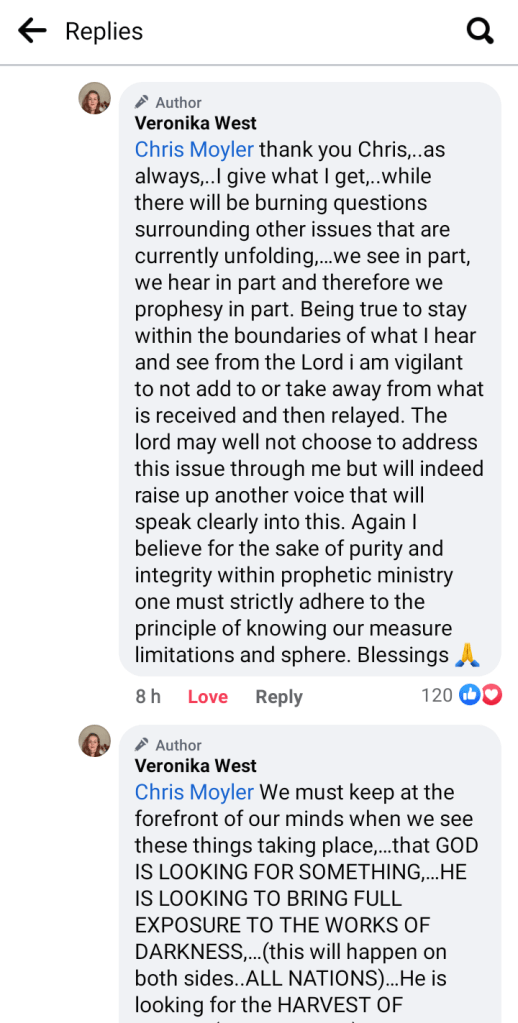

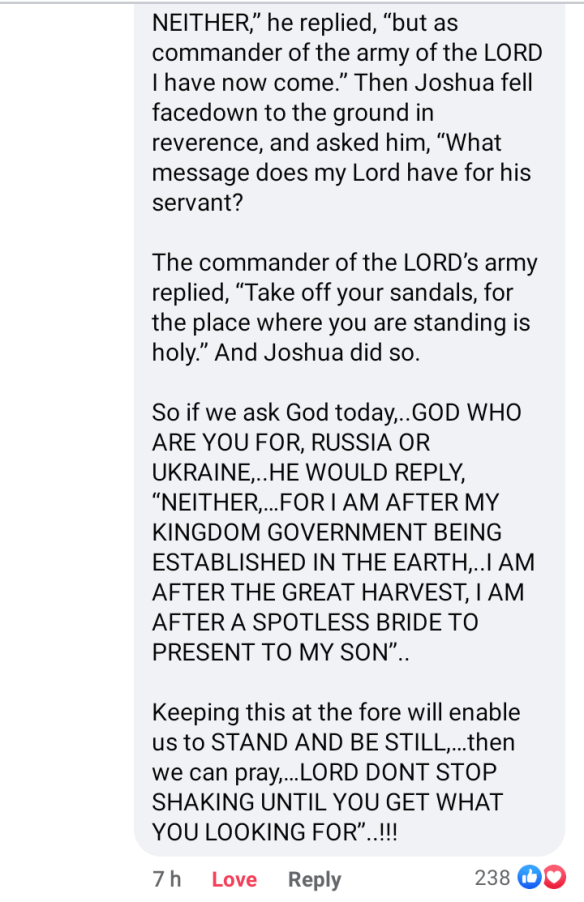
After I shared that word onto my personal Facebook our sister over the Pond in Nova Scotia, Maxine Davis, replies to a comment querying Veronika’s accuracy by saying:
“I’ve seen how her words mix with the will of God and God is sovereign who changes His heart about things. It reminds me of Jesus’ words that ‘a wicked and adulterous generation looks for a sign but none will be given it except the sign of Jonah.’ The sign of Jonah, to me, is about receiving prophecy like Jonah did for the purpose of calling for repentance, or else! Once people repent, then God relents, so it looks as if the words of the prophet didn’t come true. I might be wrong on what is meant by the sign of Jonah but I’ve seen that happen many times. People respond to calls for repentance and God changes His mind about what He speaks through prophets.
I’ve learned to combine what I hear through Veronika with what I hear from God for myself. When Trump was elected I knew what I heard from God myself, also confirmed by what she was hearing, including one of the last words about God not sharing His glory with another.”
In part 2 I will consider how what Veronkia has brought ties into Bible prophecy….
[Endless Bridge by Evgeni Denev, courtesy of Freedigitalphotos.net]
PS 1st May: NB : PROPHECY Re. “MAY” TIME & TRUMP >
Further to the previous posts on these difficult days I just love ‘Now’ words relating to their being in Father’s Timing, as in my first email of 13 years ago on hearing ALL Bible prophecy “is about to be fulfilled!” Chris posted this yesterday, emphases mine:
THE TIME IS NOW
 This is not a new prophecy but confirmation of everything I’ve been hearing these last three days. Yes, these past three days I’ve heard prophecy, I’ve heard God speaking, I’ve heard so much about ‘suddenly’, and ‘turn around’, but what stands out is the one phrase – “The Time is Now”. The great RE-SET, God’s Great RE-SET, is upon us.
Now, when I heard this, I hesitated. I asked the Lord to confirm this as I don’t want to bring another false hope to people who have had one false hope after another given to them with barely perceptible movement either way. But the Lord confirmed this with three phrases, spoken to me today as I waited upon Him. Continue reading
21 Also He said to them, “Is a lamp brought to be put under a basket or under a bed? Is it not to be set on a lamp-stand? 22 For there is nothing hidden which will not be revealed, nor has anything been kept secret but that it should come to light. 23 If anyone has ears to hear, let him hear.” (Mark 4)
Continuing from previous post on New World Order with these very important prophetic words brought by Robin Bullock and told on 7th March:
Extracts from auto-transcript dated 7th March (please excuse editing issues)

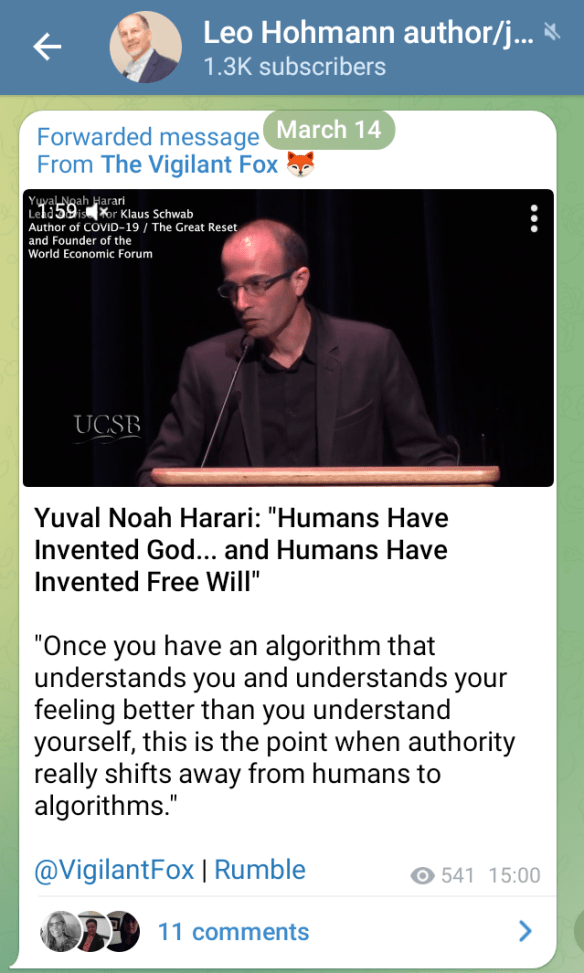
People often ask me, where does Klaus Schwab get his bizarre, indeed frightening ideas about transhumanism, globalism and technocracy? Who shapes his worldview?
Let’s start off by stating upfront that every Western leader you see on the world stage right now is a puppet of the New World Order. His ideas are not his own but are coming from Satanic inspiration.
So the question is, who is whispering into the ears of Biden, Trudeau, Macron, Johnson, Zelensky and the other front-men for the global Great Reset? […]
Who influences the influencers? Meet Klaus Schwab’s chief adviser — LeoHohmann.com
THIS IS ESSENTIAL BACKGROUND READING REGARDING THE 4th BEAST SEEN BY PROPHET DANIEL AND THE TWO BEASTS SEEN BY APOSTLE JOHN.
I wonder, could this Israeli historian become the prophesied AC as he’s speaking on the mechanisms necessary for full implementation of the Mark of the Beast…??

TAKE NOTE, for example:
“He is your model transhumanist who thinks he can become god,” Wood told me. “He is the chief philosophical adviser to the World Economic Forum and one of the premiere authorities in WEF circles. They just hang on his every word.”
The level of evil we are dealing with here is so intense that most Christians and conservatives have no idea how deep it goes and will frankly have trouble believing it. No politician is going to be able to save us from this evil, only Jesus Christ.
…The reason a digital currency will soon be needed is because the hard currency represented by physical paper and coinage are going to be phased out shortly.
And the decisions to this end are not being made at the presidential level. The drive toward a global digital money system involves decisions made by people at a much higher level, the top tier of international bankers such as the Rothschilds and others whose names most of us would not recognize (Jacques Attali could be one of them). The decision has been made and there will be no stopping it short of God’s supernatural intervention.
As I previously reported, everything we see happening on the world stage right now is geared toward the emergence of two things – the creation of a digital global ID system (it will launch as a simple vaccine passport but evolve into a universally recognized, overarching ID) and the creation of a digital global money system. The World Economic Forum has been openly pushing for both of these.
Once those two things are in place – digital money and digital ID for all persons – the global predators can proceed with the creation of a truly one-world system under which nothing will happen outside of their surveillance and control. Every transaction will be monitored. They will know what you bought, where you bought it, and how much you paid.
Next, we’ll consider prophetic words brought by Robin Bullock on 6th March which are most illuminating on the above matter…

Two nights ago in a dream, I was walking on a path in a wooded area that was dark and wet. All the sudden, I found myself surrounded by large yellow frogs with black spots. I looked around and they were everywhere, seemingly on guard and ready to move. I was very unsettled as they seemed to be on task.
I woke from this dream knowing immediately that it was a warning, not only for me personally, but for other prophets and prophetic intercessors. I believe the brief night parable is providing some key details as to the enemy’s strategies in the coming days and how to stand against them…(omitted)
I believe these few descriptions in the natural provide some powerful parallels in the spirit. The Lord is showing us a picture of how the enemy is going to try and attack prophets and prophetic intercessors and those who are standing for truth in dark places….WARNING DREAM FOR THE PROPHETS —
Upon finding this morning the above ace article by Wanda Alger it not only fits into the dream I had just before waking, but also perceptively confirms the suspected spiritual source of ‘friendly fire’ I’d come under upon returning to base, after having come under heavy internet flak on approaching ‘target’ to drop this bombshell > November 2018 prophecy implies American politicians brought us to doorstep of World War III.
‘THOSE WHO HAVE FED ON LIES ARE ABOUT TO SHOOT TOXIC ARROWS OF ACCUSATION’ aptly describes the continuance of those sniper shots, but the Lord knows their source and in His mercy will deal at the best time.
Wanda also explains this morning’s waking dream of seeing surround-windows I was looking through get transformed into walls of fast-running water. On getting dressed I was reminded they looked like wall-to-wall showers for decontamination purposes!
On Friday Chris G Bennett published this absolutely ACE on his Facebook, which not surprisingly attracted a couple of dozen comments:
DARK DAYS & THE LIGHT OF THE WORLD
 There are some dark days ahead of us. Once again it seems that Satan really believes he can beat Jesus Christ down. He did the same at Calvary, where to all intents and purposes, he appeared to have defeated to Son of God by having Him killed on the Roman cross. But, three days later, Jesus rose from the dead, collected the keys to death, hell, and the grave from a very surprised Satan, and ascended to sit at the Father’s right hand – exactly as prophesied in scripture for centuries beforehand.
So what does Satan expect this time around?
Much biblical prophecy points to these days – “wars, rumours of wars”, “nations and leaders raising themselves up – way beyond their capabilities”, earthquakes, fires, storms! Everything pointing to mayhem and Satan having a ball at our expense. Yet, as with the original scenario, prophecy points to a very different outcome!
Prophecy, biblical and 21st century, points to a ‘Great Falling Away’! Is this not happening? Have not great swathes of the church followed their own teaching rather than God’s? Is there not a great watering down of Christ’s gospel message – no heaven, no hell, no repentance, no death to self, no humility, etc etc? Has the church not virtually extinguished the ‘Light of the World’. And has its salt not become bland and tasteless? Nearly every prophet worth the name has spoken into this.
But also, nearly every prophet worth the name has also spoken of the final harvest, the great gathering in, otherwise known as end-time revival. Prophecy, both biblical and 21st century, is full of signs, wonders, miracles, and ‘greater things’ that Jesus spoke of, alongside a great harvest of souls yet to come to salvation. Just as it did two thousand years ago, history will record that Satan once again tried and failed to oust the Son of God from His position as the Light of the World.
As I said, there are some very dark days ahead. I believe we will go right to the very edge of war and Satan will even appear to have won. BUT – God will turn things around. Satan will walk right into the Lord’s hands, as God turns everything round. There will be a great revival, there will be great persecution against Christians, there will be a huge upheaval in politics – particularly in America and Europe. The ‘swamp’ will be drained – Trump will be justified and returned to his rightful place – China, Russia, North Korea, and other aggressors will once again back off from their sabre-rattling stance. In fact, I believe Russia and America will become allies – albeit a little wary of each other – and a new respect will be established between them. I also believe the CCP will suddenly dissipate into a much less powerful and aggressive state.
Yes, dark days are coming, but the Light of the World has yet to have His say on everything. And the Rapture? Who knows other than the Father Himself – even Jesus said He doesn’t know. As the Word of God says, so many times, “FEAR NOT” for God is still in control and everything is safe in His hands! Glory to God and Hallelujah \o/
CGB 11 March 2022

Just a FEW recent news subsequent to my previous in this series. (See #3 below on danger of spike proteins):
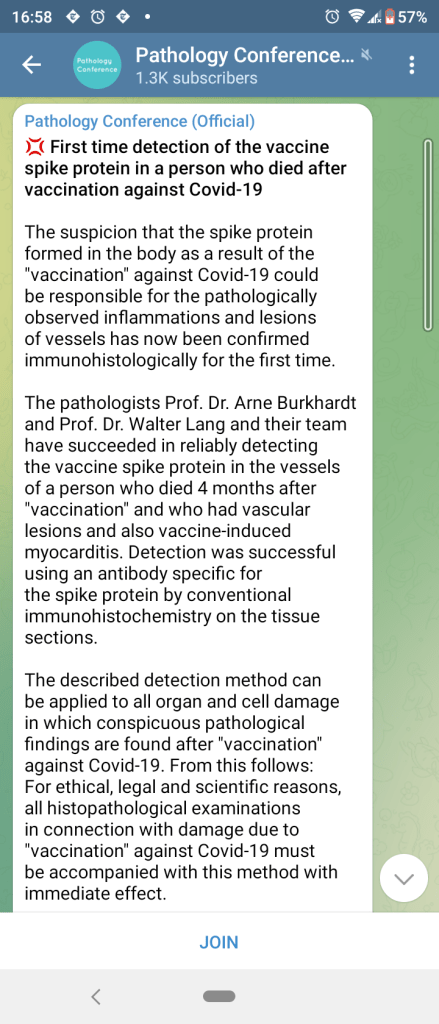
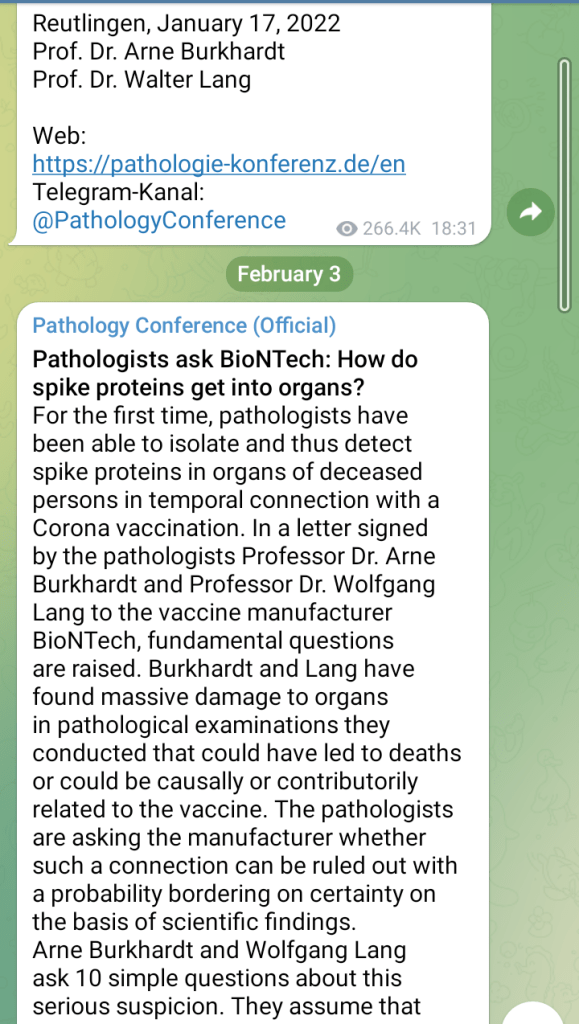
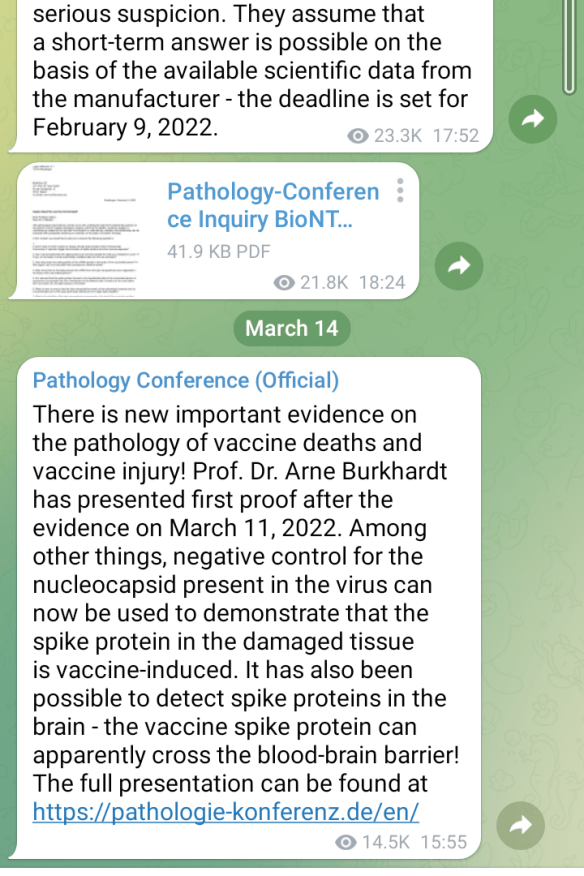
From 8th March: Continue reading
[Originally published 30 March 2020] Before delving into what the Lord told Charlie two years ago about the likely origin of the current ‘distraction’ (as Tomi and Dr Sharon refer to it), in view of expressed concerns on this contentious topic it’s necessary to explain and note a few ‘God-incidents’…(see original post for Introduction)
THE VISION
I recalled having read the original around the time I was blogging on the words he’d brought on earthquakes, but deemed it wiser not to re-publish another on what can engender fear. Now, however, we can appreciate the vision being of direct relevance to possibilities of the origin of ‘Chinese Flu’:
THE MANTLE OF ABUNDANT LIFE (released 29th May, 2018)

I recently had a troubling vision that I believe will require intercessors to take very seriously and pray into during this time. In this vision I was carried to a place that seemed to be a makeshift laboratory. As I looked around I witnessed someone creating a sinister plan to harm humanity. I could see a laptop filled with thousands of files containing schemes, bomb-making instructions, and research on building home-brewed biological and radiological weapons.
While I stood and looked God brought me into a microscopic dimension where I could see past the view of the naked eye and into a much deeper realm. I could see microscopic organisms that were being created with the intention of spreading bacterial infection to wreak havoc on many; a bio terror attack. The Lord spoke to me and said,
“There are terror cells hidden in America and the nations of the earth. Satan has managed to infect men’s minds with demonic plans involving the intentional release of biological and radiological agents to harm many, they are planning it even now. Those that would commit such demonic acts are filled with the most deep spirit of darkness. The devil used disease from the beginning to destroy humanity, but my Son was manifested that he might destroy the works of Satan in the earth. My church must rise in this hour and pray against these terror attacks that the enemy wants to bring. If they will pray the attack will be uncovered! For there are multitudes, multitudes in the valley of decision who have yet to receive me as Lord, but to those that fear My name will the Son of Righteousness arise with healing in His wings. I will cover the people with My feathers and under My wings will they find protection. They will have no fear of this terror, nor for the pestilence that walks in darkness; nor for the destruction that seeks to lay waste in cities. I the Lord will be their habitation there will be no evil befall them, neither will any plague come nigh their dwelling.”
Suddenly I saw a mantle, that looked as though someone of royalty would have worn it, fall to the ground. I heard the Lord say, “I’m offering this mantle to many in this hour, but who will carry it to the ends of the earth for My glory?” I asked the Lord, “What mantle is it?” I heard the Lord say,
“It’s the mantle of abundant life! For the law of the Spirit of life in Christ Jesus has made you free from the law of sin and death. There was one who carried this mantle many generations ago; My servant John G. Lake. He carried it throughout the earth and displaced disease, darkness and death. Through his hands the most deadly diseases were brought to nothing and cities came under My hand of protection and prosperity. This mantle is coming again in the earth to combat what the enemy has set in place to come, but who will carry this mantle for My glory? If My people, which are called by my name will humble themselves, pray and seek my face they will receive it. I will come to work with them, healing and protection will be in their land. I will send My word and heal those around them, deliver them from destruction. I will deliver their soul from death, their eyes from tears and their feet from falling. Behold, I will bring them health and a cure. I will reveal to them the abundance of peace and truth found only in My Kingdom. A true Apostolic authority is about to be revealed that has not been seen in many generations. One that will be known not by title, but by Acts! One that carries authentic power to heal all manner of sickness and all manner of disease among the masses. Where the enemy would use some to kill, steal and destroy this anointing will come to bring life and life more abundantly. And there will be a sign that follow those that receive, if they drink any deadly thing it will not hurt them.”
I could see the protection of God’s hand come over regions and bio terror could not penetrate past the vail of the mantle. I saw churches that became distribution centers that released peace upon cities and regions. They had the ability to expose darkness by prayer and secret terror cells were uncovered. I know what I was shown and we must not be slothful in prayer at this time. We must be diligently seeking God for the protection of the nations. We must earnestly desire this mantle of abundant life to come upon the leaders of the body of Christ. I’m calling upon all believers and intercessors to begin to pray this word through and cover your cities with Psalms 91. I believe it is a mandate from the Lord as I can still hear his voice saying, “but who will carry this mantle for my glory?”
Prophet Charlie Shamp, Destiny Encounters International
Well, I’d planned to continue from my footnote to the previous post on the ‘The Bone & The Treaty’ prophecy with prepared material on the receipt and purposes of prophecy, BUT this morning other material jumped in my face! NOW, I understood how I was able to break into the luxury of quiet Sunday offline and post Veronika’s urgent word!!
The very fact of the continual difficulty I’ve had in posting this and losing text indicates I’m ‘bang on target’ metaphorically speaking! (Again not only emails not connecting but also erratic broadband, which crashed when tried to publish at 14:14 – maybe this is far TOO HOT for my ISP! No, a hour later still got bother trying to check a booking AND then it crashed again whilst writing. So changed from pc to chromebook, which looks like it’s working! Now back on proper screen-keyboard.)
1st. This was near the top of my long stack of unread emails from Dr Malone along the lines of what I’d been musing over:
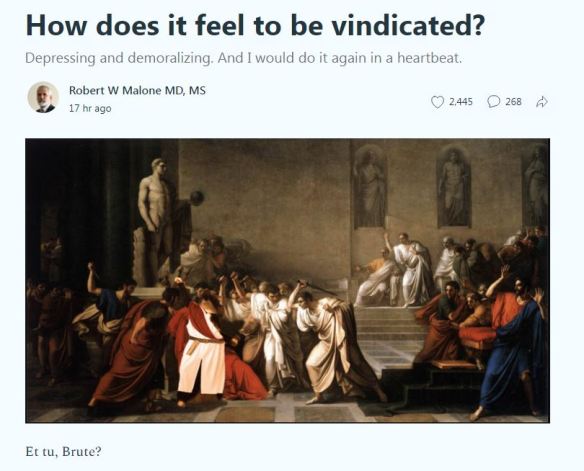
Therein, the inventor of the mRNA vaccine technology confirms (emphases mine),
‘The biomedical world that I thought I was living in has been revealed to be a sham. The legitimacy of the industry and discipline that I have committed my entire professional life to is in shambles. I am now embarrassed to call myself a vaccines and bio-defense expert, because the fundamental corruption inherent in those domains has been so clearly revealed. I cannot unsee what I have seen. I cannot recapture all of those years spent in a profoundly corrupt academic system, spent supporting a deeply compromised discipline which appears primarily driven by financial interests rather than by what I had naively believed was a commitment to saving lives. I chose to not pursue the careers of my father and father in law, which were spent building weapons of war, only to find that I had inadvertently played a significant role in enabling one of the most tragic medical follies in the history of man.’
2nd. Next, I was reminded of the heart of this issue upon opening Facebook only to find the top notification wherein my friend Geoffrey Pick had specifically tagged me into an item posted on Prophetic Releasers for UK Revival, and which appears in next post:

3rd. Moreover, then along comments my friend Chris Moyler with this ace link:

 Although unsourced the video is compelling, high-level technical testimony. At 8 minutes Dr Fleming tells how coronavirus was found to be engineered for no similar variety of such a built virus exists naturally. He is author of the following:

Therefore, it can no longer be regarded as conspiracy theory but an irrefutable fact that several prophets correctly heard – including myself – that coronavirus-19 is man-made.
New Preface 1 Oct: Veronika is on her Facebook page and His Kingdom Prophecies where her latest reads: ‘So, I am sharing this Prophetic Warning again with you all today which was received on 22 June 2022. I have spent almost 3 months praying daily over this Word, and The Holy Spirit instructed me to post today. Please weigh and carefully pray over it before just sharing. It’s a weighty Word that requires serious Prayer and Warfare – URGENT Warning : A Threat of Nuclear Weapons.‘
This Featured post reads:
On Saturday Veronika posted the following on what she’d received on Friday 11.3.2022, as published on His Kingdom Prophecy. It is especially interesting regarding the Lord’s confirming the ongoing fulfillment of my musing in May 2016 on His exposing evil and political rot.:
RUSSIA, POLAND AND THE BALTIC LANDS – THE BONE AND THE TREATY
The LORD spoke to me during my time a prayer yesterday, as I cried out to Him concerning The Nations and how He wants me to position myself Prayer in the coming days.
This is what I heard. I heard these Words, “Watch! For in the days ahead, they will seek to throw The Great Bear Nation a Bone, to stop The Bear from taking yet another bite! Continue reading
WHAT IS THE BOOK OF REVELATION FOR? – Part 2: THE LETTERS
 In the Introductory article (Part 1 of this series) I made no mention of the 1st chapter of Revelation. So, for completeness and before proceeding further, I attach (at annex A below) a review of the 1st chapter, as a necessary lead-in to the examination of the letters in Chapters 2 and 3 of Revelation.
The letters to the 7 churches contain comments that can only be understood by referring to the prophetic chapters that follow them. My assessment will seek to link the most significant observations in each letter to the relevant clarification / expansion in the chapters that follow.
But first, some observations on the structure and common factors. They all start with an address to the angel of the particular church, followed by a different characteristic of Jesus for each. Five churches are complimented; two are not: Sardis and Laodicea. Five churches are reprimanded; two are not: Smyrna and Philadelphia. All are given advice, and all are encouraged to have an ear to “hear what the Spirit says to the churches” (note that we should listen to what is said to all the churches). Each church is told what “He who overcomes” will receive.
What do the letters promise “to him who overcomes”?
The overcomers of the Church of Ephesus are assured that they will eat from “the tree of life”. The clarification: “Blessed are those who wash their robes, that they may have the right to the tree of life and may go through the gates into the city.” (Rev 22:14). The overcomers of the martyr Church of Smyrna are promised the crown of life and that they “will not be hurt at all by the second death.”
What is the second death, and who will suffer it? The prophecy explains: “the cowardly, the unbelieving, the vile, the murderers, the sexually immoral, those who practice magic arts, the idolaters and all liars—they will be consigned to the fiery lake of burning sulfur. This is the second death.” (Rev 21:8). “Then death and Hades were thrown into the lake of fire. The lake of fire is the second death.” (Rev 20:14).
The Church of Pergamum overcomers are promised hidden manna and a white stone with a new name written on it. There are no direct references in the subsequent chapters; however, hidden manna may well refer to “the bread of life”; “This is the bread which comes down from heaven, that one may eat of it and not die. I am the living bread which came down from heaven. If anyone eats of this bread, he will live forever; and the bread that I shall give is My flesh, which I shall give for the life of the world.” (John 6:35 & 50-51). The “white stone with a new name …” has been the subject of much speculation. There are references to a new name: “ … you will be called by a new name that the mouth of the Lord will bestow” and “… to His servants He will give another name” (Is 62:2 & Is 65:15) but the full meaning of the white stone reference has yet to be revealed.
To the Church of Thyatira: “to him who overcomes, and does My will to the end, I will give authority over the nations – He will rule them with an iron sceptre; he will dash them to pieces like pottery …. … I will also give him the morning star.” In the subsequent prophetic chapters, the shaking of the nations is portrayed. A woman clothed with the sun, and crowned with twelve stars gives birth to a son who will rule all nations with an iron sceptre (see Rev 12). The morning star is Jesus (Rev 22:16), who will “rises in your hearts” (2 Pe 1:19).
The Church of Sardis, which had a reputation for being alive but was dead, is told to wake up and strengthen what remains. There are no good comments; even so, a few overcomers will be dressed in white and will not have their names erased from the book of life. Later, at Rev 20, we see the book of life opened and at Rev 21, that only those named in the “Lamb’s book of life” will be able to enter the New Jerusalem.
The Church of Philadelphia, receives the encouraging promise that the overcomes will be made pillars in the temple of my God; and “I will write on him the name of my God, .… and I will also write on him my new name.” At the start of Rev 14 we read: “Then I looked, and there before me was the Lamb, standing on Mount Zion, and with him 144,000 who had his name and his Father’s name written on their foreheads” (see also Rev 22:4). Two other encouraging comments are: “I have placed before you an open door that no one can shut” and “I will also keep you from the hour of trial that is going to come on the whole world to test the inhabitants of the earth”. I have often heard the former used in prophetic words given to individuals, and the latter is sometimes used in support of the pre-tribulation rapture argument.
Lastly, the lukewarm Church of Laodicea, which boasts about its material wealth while not realising that in God’s eyes it is wretched and miserable and needs to repent. Even so, Jesus shows His long-suffering love: “Here I am! I stand at the door and knock,” and to those who overcome: “I will give the right to sit with me on my throne, just as I was victorious and sat down with my Father on his throne.”
In Part 3, we will look at significant aspects in the chapters that follow the letters, some of which we have commented on above.
Annex A Continue reading
Readers may recall my astonishment over The Great Rethink: Back to Basics, Bible Prophecy by dear Neil Mackereth published six weeks ago, comprising part of a totally unexpected triplet as the 3,600th posting on Richard’s Watch. Recently he sent me this most helpful paper, as follows:
Hi Richard, Do hope you and Nina are well.
Every week we seem to be facing yet more turmoil and danger as the world creeks and groans its way towards the final denouement. I feel urged to try my utmost to get people to take Revelation seriously! I embark on a number of papers to try to encourage more interest by demystifying that which can be demystified! But still recognising that some things await revelation as they unfold. I hope it will be helpful.
May the Lord continue to bless, encourage and guide your thoughts and actions. Neil
WHAT IS THE BOOK OF REVELATION FOR? – PART 1: AN INTRODUCTION
 The prime purpose of the Book of Revelation is to give the Church all the information it needs to be victorious in the time of tribulation (which is very near) which precedes the second advent of Jesus. The Bible opens with creation and man’s fall; it ends with victory. In the early stages, Satan is triumphant; at the close Satan is conquered, and the redeemed are with Jesus.
In this and subsequent articles, my aim is to provide a basis for further study, in smallish chunks of understandable English. I do not attempt to address the diverse options, opinions and queries relating to different interpretations and understandings of features of the Book of Revelation, nor do I seek to change any of its content!
Scepticism and a burgeoning form of liberal humanism have taken a grip on western society. Bible truths have been reduced, at best, to the rank of eccentric opinion and harmless religious sentiment. At worst, those who live by biblical principles are seen as undermining social cohesion and in need of remedial training, or more draconian “corrective” measures. We Christians need to use every God given help at our disposal to confront this all-pervading evil. Biblical prophecy is a major weapon in our armoury; it shows clearly that God has always known the end from the beginning. God Himself draws back the veil to enable us to see, and understand through His prophets, that His strong arm has been at work throughout history. Once our eyes are open to the truths of fulfilled prophecy, it becomes clear that what appear to be disconnected shakings, confusion, chaos and turmoil (historical, current or in scripture relating to the future) had, has, and always will have, purpose in God’s providential plan. We can be absolutely certain that the prophecies which relate to the future will be fulfilled.
Jesus said, “I have overcome the world.” He now sits at the right hand of God the Father, has “all power and authority”, and leads His Church, as “conqueror bent on conquest.” In His letters, sent through John to the Churches (His witnesses on earth), He promises that those who overcome will receive the wondrous rewards of the Kingdom of Heaven. In the prophetic vision chapters that follow the letters, we gain an understanding of what the conflicts, sufferings and challenges are going to be, in the time of tribulation that comes before the preordained (ultimate) victory for Jesus and His followers. This is the theme of the prophecy, and its object is a practical one. It is a gift to the Church militant from Christ triumphant. Because Jesus has overcome the world, we too can overcome the world. Faith in God, His Word, and the authenticity of biblical prophecy therein, will make us victorious: without it we have nothing. In other words, conquering visible enemies is achieved through faith in things invisible. The conflict is both physical and spiritual: the latter includes demonic led attacks through sorcery, the occult, the apostate church and false prophets.
For the last 2000 years Christians have suffered hatred, persecution, torture and murder; nevertheless, it is the Christians who are the real conquerors, and the ultimate victory is assured! “Greater is He that is in you than he that is in the world.”
There are theologians and ministers, of various ranks and denominations, who dismiss Revelation as irrelevant. The opposite is true, it was written to encourage and strengthen Christians, to arm us for battle and to guide us to victory. It is NOT just some curious way of writing that belongs to a distant past, nor is it a myriad of strange images and visions that relate to events so far in the future that they can be ignored. Those who have not grasped its huge significance have missed the point. It is prophecy (and tells us so) straight from the Throne Room of God Almighty. The exhortations in chapter 1 and warnings in chapter 22 give clear indication of its unique status and huge importance to God. It may be difficult to interpret but it deserves close study: it is vital that any true follower of Christ does his or her utmost to grasp its importance and purpose.
In some studies of Revelation, the letters chapters are treated in isolation to the rest of the prophetic content of the book. To my mind that “compartmentalisation” is not helpful: each church has a message for us in relation to how we prepare to face the time of tribulation, and the relevance of the promises and warnings to those churches are explained in the subsequent chapters. I will expand on this in Part 2.
In Part 3, we will look at how the true Church is represented by the woman who is “clothed with the sun, with the moon under her feet and a crown of twelve stars on her head” who is forced to flee into the wilderness and remain hidden during the time of the antichrist’s dominance (Rev 12, 13). And at the woman seated upon the beast, reigning over “peoples, multitudes, nations and languages” (Rev 17): the Harlot Babylon who represents the corrupt world power structure and economic system based on selfishness, lust and greed.
In Part 4, I will endeavour to pull the threads together and provide an aide memoir to encourage further study. My hope is that by looking at Revelation with a greater awareness of what is being portrayed by certain imagery and personifications it will become easier to read and understand.
Posted last night:
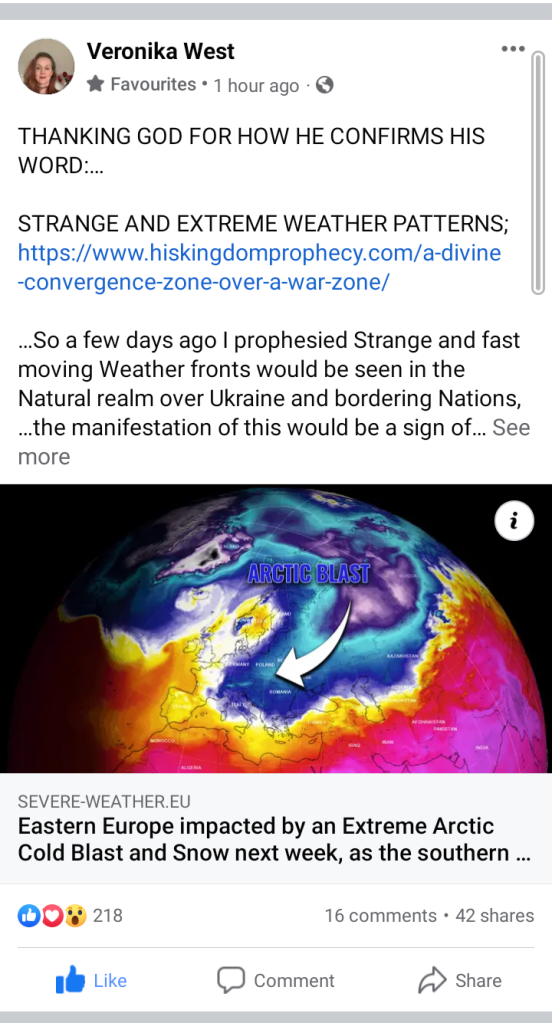
Click following image to read article
See prophetic word brought by Veronika West:
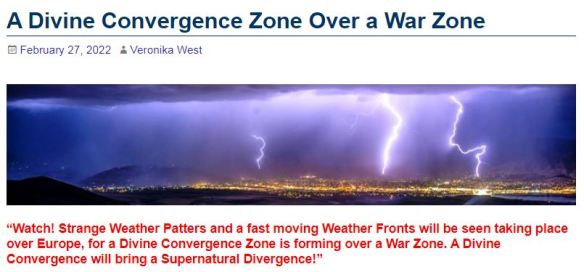 Read in full at https://richards-watch.org/2022/03/05/news-from-the-ukraine-validates-an-unusual-vision-veronika-west/
First, here’s one of the earliest reports (26 Feb) bringing this grave revelation to my attention and which I didn’t get around to blogging:
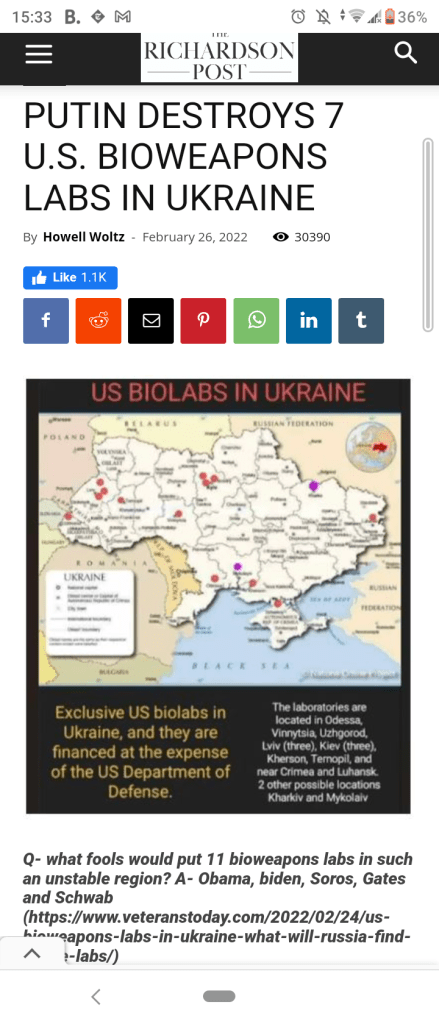
SUMMATION:

Watch video at https://www.foxnews.com/opinion/tucker-we-have-right-know-this
UPDATES:
Thank you Jean Brits for sending this with her comment on The Blame-Game has begun:
The Richardson Post (read Mission Statement) is published in Australia:
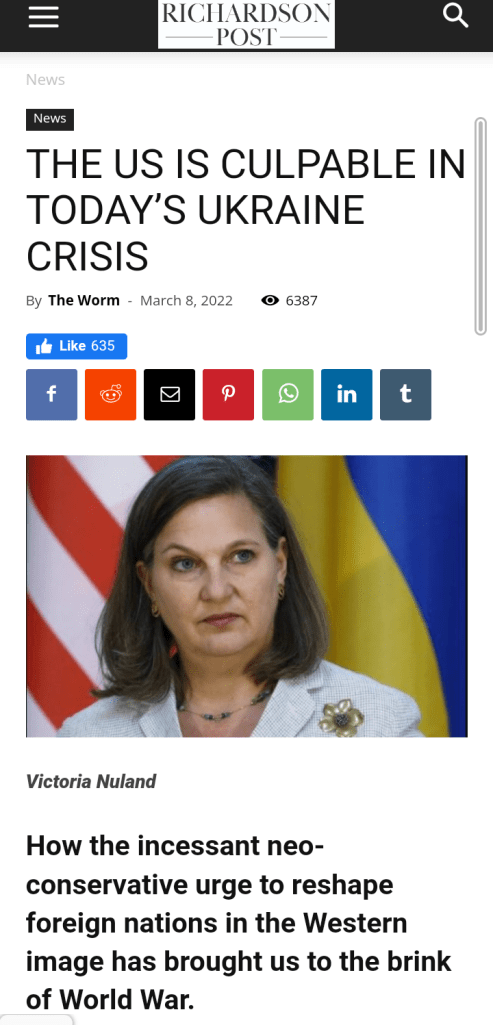
Howell Woltz is an American author an investigative reported residing in Poland:

PS:
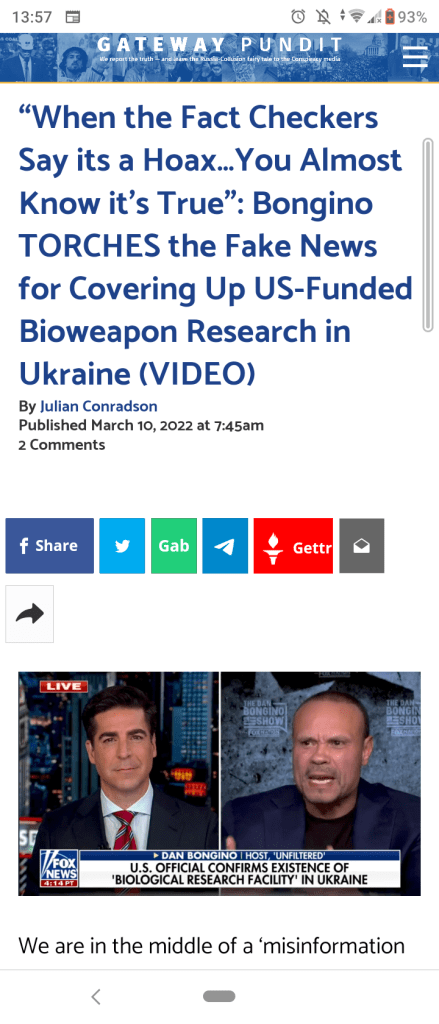
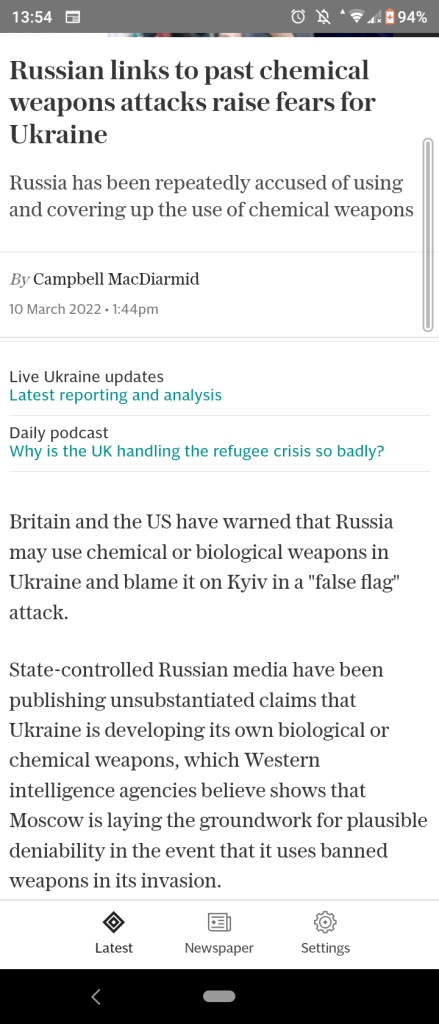
A more conservative British viewpoint:
 Richard's Watch