I’d like to share with you something new – well, new to me anyway!
Although not having literary leanings I had a very dim recollection from my school days of poetic rhythm – and in music, of course. In those days school assemblies featured some Anglican and Methodist hymns.
At Saturday men’s breakfast held at 3 Counties Vineyard, someone chooses a hymn for us to sing before we discuss the scriptures, this time (at about 8:30am) number 359:’
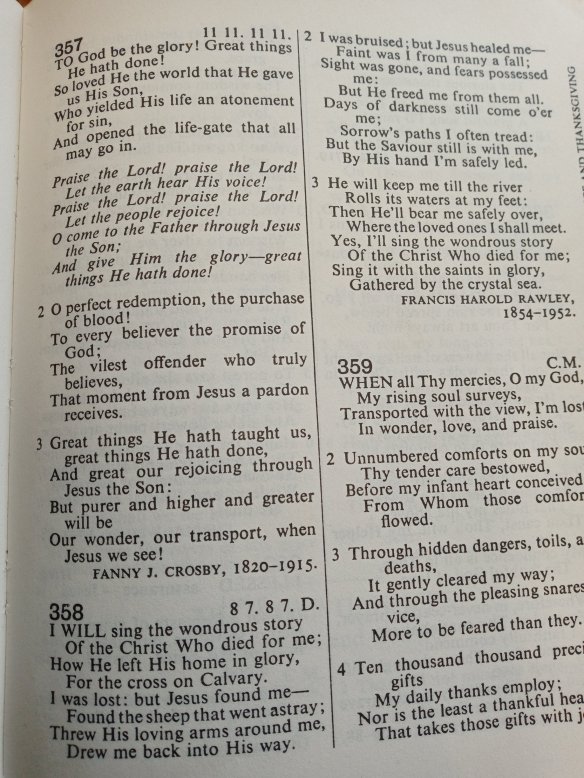
A brief discussion ensues BUT THIS TIME, because its not well-known and we have no musician, our convenor sitting at the far end of the table from me explains that the extra numbers/initials topping each hymn in this pocket-size hymnal indicate its tune. Right away a brother opposite me adds, “For example, 11-11-11-11 means each line is of 11 syllables”.
NOW MY ATTENTION WAS GRABBED – I said, “Wow, that’s the date and time I’ve already set for a post on the Book of Revelation to appear on my blog today!”
I was well and truly ‘God-smacked’!!!
I had yet to open the hymnal and not seen his example heading that page, as illustrated above: ‘To God be the Glory! Great things He hath done!’ < TRULY, AMEN >
Now, allow me to recap.:
On 31st May, Neil Mackereth sent me the latest part for his series on What is the Book of Revelation For? I couldn’t reply for a week and wanted to clarify about some translations of Rev 22:20 of Greek ‘Tachu’ (Strongs G5035). So his reply got included that part. BUT note that we’d also discussed when it should be published over the weekend. I prepped it last Wed/Thursday and suggested scheduling for automatic publication at 10:10am on 10th June but this changed, as told in that post:
‘Also, in our chat over Rev 22:20 I mention some translations state ‘soon’, whereas literal Greek has ‘quickly’, which implies suddenly. Neil reminds me he writes in ‘SIGNS’ of ‘soon’ in Rev 1:1 often being translated as meaning events will take place over a short period of time, rather than our concept of ‘soon’. So, I propose scheduling this last part for publishing at 11th minute of 11th hour of 11th day of June 2022!
To my ploy Neil replies, “11th hour on the 11th sounds significant/appropriate in light of recent comments on the Battle for Britain, changing of the guard, Big Ben’s imminent recommencement of regular chiming, the quickening (exponential) pace of prophetic end times indicators (wars and rumours of wars) etc, etc. Time is short!” (American prophet Robin D Bullock goes live at The 11th Hour every Tuesday – RB’s note.)’
Note that, for the purpose of emphasis, I altered Robin’s title from ‘The Eleventh Hour’ (as on his site) thereby showing FOUR 11s – as was to turn up by way of God-incidental confirmation BEFORE publication!!!!
Now, being Monday, back at my desk I find this email from Neil sent Friday – he confirms what I’ve got in mind to write (as above):
‘I was thinking about the 11th, 11th comments: : At present Satan appears to have the upper hand – the church, Christians et al are being ridiculed, derided, attacked, oppressed and, apparently, defeated. The 11th hour of the 11th day (albeit in the 11th month) has come to signify remembering the defeat of an evil enemy.
I think there is a similar spiritual significance in Revelation 11:11:
“But after the three and a half days the breath of life from God entered them, and they stood on their feet, and terror struck those who saw them”.
I repeat, Time is Short (where “short” means it’s all going to happen very quickly)’
In preparing this I’d already checked The Footsteps of the Messiah by scholar Dr Arnold Fruchtenbaum, who explains on page 13 about Rev 1:1
‘Verse one further states that the things that are being revealed must shortly come to pass. This is often misunderstood to mean that all the prophecies of the book were to be fulfilled as soon as they were given…However, the word ‘shortly’ simply means that once the day of fulfillment comes, where will be no delay in its execution.’
REFERENCE
Cantica Sacra – Exploring the rich legacy of sacred singing:
‘Meter refers to 1) the pattern of beats in a measure of music, or 2) to the number of syllables per line in poetry and music. Most hymnals do not include time signatures in the music, and are more concerned with the second definition of meter. (For more on the first definition, see the page on measures and time signatures and the page on simple and compound meter on the musictheory.net site.)
Hymnals display the meter of a hymn or hymn tune (meter to which the text conforms) either as a series of numerals (e.g., 87.87), letters (e.g., C.M.), or a combination (e.g., 87.87.D)
Hymns Without Words – 11-11-11-11
Hymn & Poetic Metre – Wikipedia
Poetry 101 – Masterclass Articles






















 I am absolutely convinced that shortly before the return of Jesus there will be a great awakening. I believe “There before me was a great multitude that no-one could count ………. in front of the Lamb” and “these are they who have come out of the great tribulation” Revelation 7:9 and 14, confirms that view. We cannot, and should not seek to, stop the establishment of a new world order.



 Richard's Watch