WHAT A DAY, WHAT A DATE! And what a story; whether it be past, present or future version, each strand links into the grand theme. As some say, history is His story. So today’s post is more an illustrated short, but true, story.
In western churches Sunday 2nd December 2012 marks the beginning of Advent – the weeks of expectant preparation leading into celebrating Jesus Christ’s birth in ancient Bethlehem. For too many weeks, however, shops have displayed the tacky commercial side of the season.
So it is interesting to note Wikipedia’s entry on Advent, and I was especially surprised upon its emphasis being not upon Jesus’ birth, but upon His return, viz.:
Latin adventus is the translation of the Greek word parousia, commonly used in reference to the Second Coming of Christ. For Christians, the season of Advent anticipates the coming of Christ from two different perspectives. The season offers the opportunity to share in the ancient longing for the coming of the Messiah, and to be alert for his Second Coming. The theme of readings and teachings during Advent is often to prepare for the Second Coming while commemorating the First Coming of Christ at Christmas. With the view of directing the thoughts of Christians to the first coming of Jesus Christ as savior and to his second coming as judge, special readings are prescribed for each of the four Sundays in Advent….
Readers familiar with my personal story may recall Advent’s significance in this blog’s raison d’etre (details at close of this post). And once again I’m astonished by something relevant, and which I hope will be an encouragement to readers seeking God or already walking with Him. So let your imagination follow me in what happened…
Last Sunday
‘On a roll’ getting off to church I realised I wasn’t carrying my hefty New King James study Bible so, approaching our front door, I grabbed my old New International Version Insight Bible. After scraping thick frost off the car’s windows I drove off. It’s an easy 22 miles via the 1-year old Hindhead Tunnel, and bursting through into brilliant sunlight brought splendid views over the Surrey hills.


A mother and baby were picked up en-route and, arriving later than usual at a school cafe outside Godalming, there was time for a quick coffee before the service started at Well Church International. The young chap on guitar leads those gathered in worship of the Living God. As everyone focuses upon Jesus, however, “John 13” pops into mind. So I pick up my Insight Bible from the table and check it out, trying not to distract others.
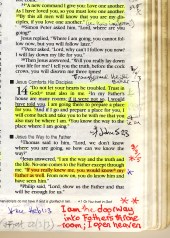
My old, floppy paperback Bible is well-worn, some verses covered in yellow highlighter and marginalia jottings on teachers’ remarks, and my own thoughts, as seen below…
“ Is there something specifically for me to read in John13, Lord?” The headers therein are ‘Jesus Washes His Disciples’ Feet’, ‘Jesus Predicts His Betrayal’, ‘Jesus Predicts Peter’s Denial’. Nothing stood out other than verse 13, “A new command I give you: Love one another….By this all men will know you are my disciples” Then it leads into chapter 14 where Jesus tells them not to be troubled about what’s going to happen, that He’s going to, “Father’s house…to prepare a place for you. I will come back and take you to be with me that you also may be where I am. You know the place to where I am going…”
Thomas butts in, “Lord, we don’t know where you are going, so how can we know the way there?” Jesus answered him with that well-known personal attestation,
“I am the way and the truth and the life. No one comes to the Father except through Me. If you really knew Me, you would know My Father as well. From now on you do know Him and have seen Him.” (John 14:6-7)
I notice my annotation in red made during a conference 7 years ago, then ponder if any of this may be of signficance – and what that may be!
 Putting my Bible down I get back into worship – only to pick it up minutes later to focus upon those verses. A few minutes later young Danny motors straight into a new song about the door into heaven – and my jaw drops. I’ve just read that in my jottings!
Seven years ago a teacher said verse 14:6 means, “I am the doorway into Father’s throne-room; I open heaven” (see note in red in image to left). A couple of minutes later I go to the front and read this scripture and refer to my explanatory note to encourage everyone.
Mmmm very interesting, especially in view of what had happened only last week.
Later, sitting at the table and completing our offering envelope I question myself about the date. “Yesterday was Nina’s annual spiritual birthday party, that is 1st Dec so it’s 2nd”, I thought. THEN, the moment I start writing ‘2/12…’ I’m hit by that number. [For her birthday card I’d wanted to quote the opening lines of Psalm 91 and took out an old NIV of hers only to find she’d annotated it’s start with ‘God our protector’. So I used those words for her card. As evident from these two events, it’s clear that He knows our jottings!]
I’d had occasion to discover ‘212’ again just before writing about this blog’s anniversary, as here. Last December I’d been impressed with the possible connection of a house number with the new year of 2012. After all, it’s just any old house, any old number. Yet between then and now a tiny thought had made me wonder if it may be something to do with an actual date in 2012. Then I completely forgot all about that! Until now, that is.
But that was nothing to what was to follow…
Our minister Lindi Masters had returned home to South Africa for Christmas but not without printing December’s diary sheet. Copies of this were on each table and I’d not had chance to see it until after our visiting German pastor’s message. After he finished I took the sheet and turning over was stunned!
 There, on its reverse, is a copy of the latest news-letter from Paul Keith Davis but abridged to make ‘The Open Door’ its leading sub-header! AND it just so happens I’d received my own copy of his newsletter only three days earlier – AND during that very night, whilst wide-awake, I’d already been blessed to see the door to which he refers! As I’d lain awake in bed but eyes closed, I sensed in the middle of darkness an open doorway, but devoid of door, and beyond which was nothing but gentle light. (Click on image to read, and for full content Paul Keith’s newsletter click here.)
No wonder I was utterly stunned in amazement by these three ‘coincidences’ on the ‘open door’! Is it all a ‘sign and a wonder’? Bemused, I next recalled that the ‘212’ house number of my childhood home was affixed to the top of the front door. So could the insertion of a zero suggest an open door, or portal, indicating that 212 could become 2o12? This speaks to me of two kinds of home addresses, one earthly and the other heavenly. I wonder…
Note: the date of my Bible’s note is ‘3.3.5’, which is exactly 7 years 9 months ago, or 93 months ago. Although not into detailed numerical anlysis I can’t but help noting these digits total 12 (9+3=12), and we’re in the 12th month of the 12th year of this century.
All told, an exciting start to Advent. What could it portend?
Further reading:


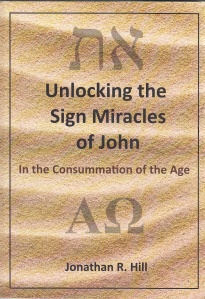
 The book is based upon the work of Arthur Ware in The Restored Vision and quotes from Dr Grattan Guinness’ Light For The Last Days (an author used in The Invisible Hand, so influential upon me, as in my