
Now where was I? Ah yes share last item to Facebook and go back to post-breakfast and a most notable item that had popped onto its home screen and got shared:
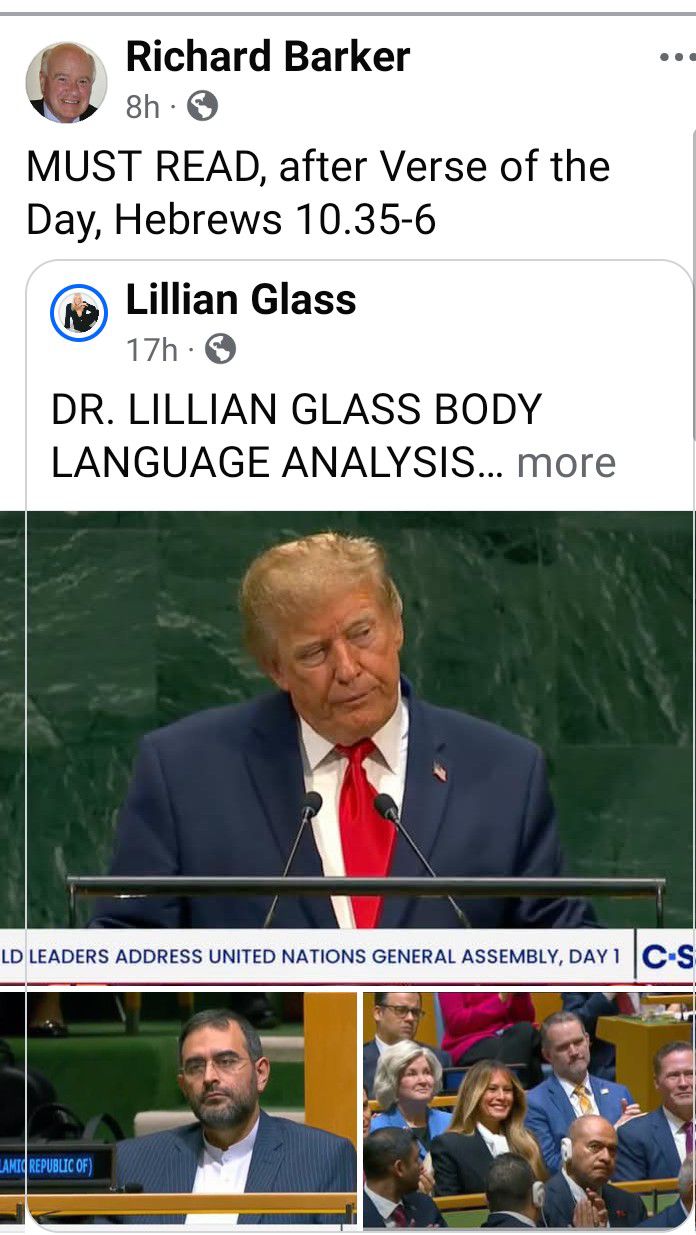
DR. LILLIAN GLASS BODY LANGUAGE ANALYSIS: TRUMP AT THE UN — CALM, ARTICULATE AND REMARKABLY FOCUSED IN ONE OF HIS BEST SPEECHES EVER.
Before anyone attempts to silence my professional observations because they either love or hate Donald Trump, understand what I do. As a body-language and communication expert, I report what I observe, not what someone wants me to see. My analysis is not determined by someone’s politics, nor is it determined by the fact that I have attended charity events at Mar-a-Lago. I analyze what is directly in front of me, and what I saw in President Donald Trump’s speech before the United Nations was remarkable.
In my observation, this was one of Trump’s best speeches ever from a communication and body-language standpoint. He was calmer than I have seen him in many previous major speeches. He was articulate, measured, and remarkably focused. His posture was solid and centered. He did not wander around the stage. His movements were controlled. His cadence was deliberate, and he largely remained focused on his prepared remarks instead of continually going off script. Even Reuters described this appearance as less dramatic than his 2025 UN address.
There was also virtually none of Trump’s characteristic humor. To me, that was significant. This was serious business, and his demeanor reflected it. He did not need a joke or an aside to connect with the audience. He appeared to understand the gravity of what he was discussing, and the restraint strengthened his communication.
Trump began by speaking extremely positively about America. He spoke of the economy, border security, declining crime, American technology and what he described as America’s renewed strength. AP reported that he highlighted his administration’s domestic record on the economy, immigration and crime before turning extensively to foreign affairs. These were Trump’s political claims about his administration, but what interested me professionally was how he delivered them. He spoke about America with tremendous confidence and pride. As I listened to him present the United States as strong, successful and desirable, I thought that his description certainly helps explain why so many people around the world aspire to come to America.
Then the energy of the speech changed dramatically when he turned to Iran. Yet Trump himself did not become dramatically more animated. That contrast fascinated me. The words became enormously consequential while the man delivering them remained remarkably controlled.
Trump laid out an extraordinary dilemma. He asked whether an agreement could be reached that would allow Iran to rebuild and potentially become a far greater country, or whether he would “annihilate the Islamic Republic” if no agreement were reached. He also said he believed an agreement could come after the November midterm elections and argued that Iranian leaders were waiting to see what happened politically in the United States.
As Trump discussed this enormous decision, I noticed a slight cocking of his head. To me, his expression and movement conveyed contemplation and sincerity. Obviously, body language cannot tell us precisely what someone is thinking, but it can tell us what behavior we are seeing. At that moment, I saw a man presenting what he regarded as an extremely serious choice, and his physical demeanor matched the gravity of his words.
And then came another fascinating visual moment. As Trump discussed Iran and defended American military action, most of the Iranian delegation walked out. One Iranian delegate remained seated. AP reported that Iran’s president and foreign minister were not actually in the General Assembly hall during Trump’s address; lower-level Iranian officials and delegates had been seated there, and most left roughly ten minutes into the speech.
I watched the face of the Iranian representative who remained, and I found his expression telling. He appeared solemn, still and intensely focused. I cannot tell you what was going through his mind, and neither can anyone else simply from looking at him. But figuratively, it looked to me as though the wheels were turning. His expression appeared to register the gravity of what he was hearing. While others walked out, he stayed and listened.
Trump also called upon other nations to stand with the United States against Iran and argued that Iran must never obtain a nuclear weapon. At other moments, however, he graciously acknowledged other countries and their contributions. That was another communication characteristic I noticed throughout the speech. He could be extraordinarily forceful one moment and respectful toward another nation the next.
There was also a wonderful nonverbal moment involving Melania. When Trump respectfully acknowledged the First Lady and her work, her entire face lit up. I recently analyzed Melania’s own UN appearance and saw a serious, determined woman on a mission. Here I saw another side of her. She gave one of the brightest and most genuine-looking public smiles I have seen from her. She appeared genuinely delighted by her husband’s acknowledgment of the work she was doing.
What stayed with me most, however, was Trump’s restraint. The words were explosive, but the man delivering them was not. He remained centered. He remained focused. He remained measured. His articulation was clear, and his physical movements did not compete with his message.
People can love Donald Trump or hate Donald Trump. They can debate his policies, his statistics, and his decisions. That is not what I am analyzing. I am analyzing the communicator. And from a communication and body-language standpoint, I saw a Trump who was calmer, more disciplined and more focused than I have seen him in many previous major speeches.
For me, this was one of his best speeches ever from a body-language and communication standpoint. And there is a communication lesson here that has nothing to do with politics: when your message is powerful enough, you do not have to overpower your message. Sometimes the most commanding thing a speaker can do is stand firmly in one place, control the voice, eliminate unnecessary distractions and allow the words themselves to carry the weight.
That is exactly what I observed in Trump’s speech at the United Nations.


You must be logged in to post a comment.