
Whilst playing with my school pals one of them suddenly stops, eyeballs me hard and scolds me, “You shouldn’t be at our school – you should be at the one Cat’licks go to!”
I’m stunned into silence. I can’t recall my response other than distress.
Upon reflection it’s possible I denied the accusation outright. I’d like to have responded, “So what? It’s where my parents want me to be!”
Such a riposte, however, may have plugged into something worse – parental conflict!
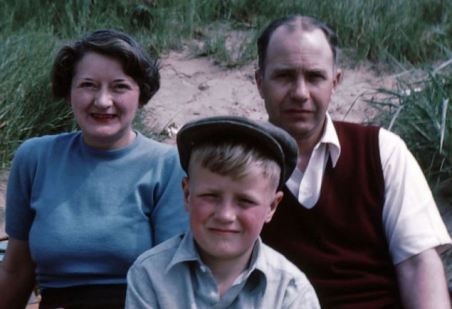
On Southport beach in mid-1950s
CONFRONTATION
It’s mid-1950s and the reality of the Protestant vs. Roman Catholic divide hit me hard. My friend’s tone clearly implied a stigma to being in the wrong Christian denomination.
Equally hard was my parents’ disagreement over my own schooling. My dear, devout Mother wanted to follow their church’s rule that Catholics send children – even of mixed marriages – to a Catholic school. But Father wanted me to have the better education provided by the more reputable of two local, state schools – the RC one had a very low pass rate for the 11+ selection exams for grammar school, which I entered in 1959.
When Dad was a boy his mother took him daily to 8am Mass. Later life taught him the value of a sound education – and my very much older cousins in mother’s family were already at college or university. So, a week or so before my 5th birthday Mum walked me the half-mile to Alexandra Park Primary School in Edgeley, Stockport.
Thus, I was brought up in the Roman church yet attended non-secular state schools with their Anglican ethos and morning assemblies. On commenting to mum that one of my classmates was kept out of assembly, she said it’s because “He’s Jewish and Jews hated Jesus!” So the ancient Catholic disdain for God’s far more ancient people was still evident in family life!
So in the 1950s, religion was a sensitive issue and far more people attended church of one sort or another, unlike nowadays.
Religious beliefs are a minor concern today, although attendance at faith schools is now prized purely for educational achievement. By comparison, most of today’s Britons are religiously illiterate – yet there’s now a noticeable, increasing attendance at churches.
Therefore, I didn’t receive the ‘mandatory’ Catholic education. My religious knowledge gained came through state-school and Sunday church. As far as from the latter was concerned, I gained little – albeit precious – because Catholic services were conducted in a dead, foreign language – Latin!
Kindly bear with me in relating how my situation affected my teenage and adult life’s journey into eventual spiritual freedom:
AN OUTSIDER
At the time of the confrontation I’d been happily playing on bikes with two boys outside one’s house. We three Johns aged 10-11 years had been classmates through primary school, yet I always felt an outsider living over 1/2 mile from school. Most of our school lived a lot closer and so, when old enough to go to their homes on my own, I was very pleased to be with seeing more of my distant friends.
But the real issue of this confrontation was in making me fear the prospect of losing the friendship I’d grown up with! Somehow details of my family’s church must have slipped out whilst chatting, or had I been seen going there? ‘Top of the class’ John seemed to see it as a stigma! The reality behind the difference of opinion at my home hit me hard – it was a reality in the outside world too!
 My earliest adventures in coming home alone from school were in walking the longer route via the local library on the far-side of school. And it was a place to explore and dig around in.
It came as a special treat when allowed to cycle to friends’ way beyond my immediate neighbourhood. Soon I began to relish the independence of exploring the rabbit warren of suburban side streets on my bike – plus learning how to read maps and navigate. Later, I’d explore for miles around, far away from the main thoroughfares – I avoided those because an older boy had been killed there and I’d seen another run over right in front of me (he survived).
The only classmates in my local streets were girls. We lived nearer to another school attended by most other ‘baby boomers’ on our patch. But its pass-rate for the secondary level of Grammar School was much lower than ours. This meant the boys I’d grown up with on ‘my block’ didn’t have quite the same schooling. So I was piggy-in-the-middle between two peer groups and didn’t feel fully accepted by either.
So, at school I was one of four Johns. Such a bore! I decided to start using my first name from the start of the next school year. So on the first day in the new class, a week or so before my 8th birthday, our new teacher went around the class asking our names. I replied, “Richard”. Everyone was shocked and they called out, “No, he’s John!”.
Miss Jackson was kind enough to ask me about this and found my reason sensible and said she respected my wishes and favoured the name. From that time on I’ve always been known as ‘Richard’. At home, however, Mum and her family refused to make any change because they’d always called me ‘John’. Maybe, because it means ‘beloved of God’. Also, being her first-born boy she’d hoped I’d become a priest – arghh, perish the thought! Nevertheless, that’s come true in a way because all believers in Jesus are priests (1 Peter 2).
So thank you Lord for this Mary and Joseph who brought me into the world and loved me greatly.
CHURCHES IN CONFLICT
At the church we attended children were not sent out of the Mass into Sunday school but were sit quietly through 45 minutes of Latin liturgy and unintelligible sermon!
It was hard for youngsters but Mum had a small book with Latin on one page and its English translation on its facing page – a Missal. When I could read she encouraged urge me to look and follow – but being artistic I took FAR more interest in the small black and white pictures displaying the Gospel theme of each Mass.
As Gospel and Epistle readings were in English I caught snippets, and recall thinking it must have been wonderful to see everything Jesus said and did – I would have liked to have been there and met Him. [The online series ‘The Chosen’ takes me back there!]
A couple of my schoolmates and nearly boys attended church just along the main road from our house. As it was so close, I asked Mum if we could go with them:
“No, ‘cos they’re Congoes,” was always her retort and she’d stress, “We go to THE church Christ himself founded!”.
‘Congoes?’, I thought that was in Africa so maybe it was a church for pygmies! But in the 1950s we had few Africans in our northern town although our doctor was a West Indian. [‘Congo’ was her term for Congregationalist.]
A year or so later I got through to Grammar School, where Catholics and Jews could opt-out of the Anglican-style morning assembly. But I didn’t opt-out and attempted to convey the impression I was non-Catholic.
Unlike today, cooperation between churches was rare seventy years ago. Hypocritical conflict between denominations drove me towards ‘New Age’ ideals. It bothered me that IF all churchgoers believe in the SAME Jesus Christ, WHY were they bitterly opposed and not friends? After all, Jesus himself commanded believers to love one another!
Also, they weren’t working miracles similar to those Jesus did, as He’d said they would.
So, churches had failed on both counts to live up to His commands. Although I was only a boy, it was obvious they’d missed the mark. Also, I suspected they’d lost a lot of what Jesus had taught. How could what priests and preachers say and do, be true?
Consequently, I started searching elsewhere for the truth > > (Continue reading).
[Bible quotations are courtesy of BibleGateway.com]


How very interesting – I didn’t realise things were like this in England so recently. I generally tend to think that the current (or perhaps I should now say recent!) low ebb of faith may perhaps have been necessary to convince Roman Catholics and everyone else that perhaps each other are Christians after all. I’m very pleased to say that where I live the RC church generally and especially its priest are enthusiastic members of the “churches together” thing. Thank you for sharing – I look forward to reading more.
LikeLiked by 2 people
Thank you and please note I’m recounting 70 years ago. After my being born anew I was delighted to find a much better and Godly harmony between churches, but some staunchly Biblical evangelicals, as one of my friends, reflects the Reformation ethos. So I drop a few hints of how the RC have improved to our mixed church weekly men’s Bible study breakfasts.
Yes I agree with your conclusion about low faith, but as prophesied Holy Spirit is definitely on the move across nations,
LikeLike