
A couple of historical points to add to Neil Mackereth’s Replacement Theology Revisited that I’d like to add are on the heritage of Jesus’ family and His warning prophecy of ‘the Abomination of Desolation’ in Jerusalem:
THE DESPOSYNI
Occasionally, I refer to the ‘Desposyni’, as for example in Jesus’ Crucifixion Described in The Holy Name of God:
‘When he made Christianity the official religion of the Roman Empire in the early 4th Century, Constantine discouraged all contact with Jews and the Church severed itself from its Jewish roots – from even the descendants of Jesus’ kith and kin, known as Desposyni. In doing so, the Church lost a fuller and deeper understanding of the Old Testament.’
Now let’s expand upon this matter with the help of priest and professor Malachi Martin, whom I seem to recall served as Librarian in the Vatican Library, in his seminal The Decline and Fall of the Roman Church published 1981 (page 34, emphases added):
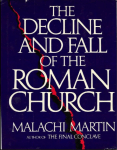 ‘..For Donatus preached the old Jewish idea of a temporal kingdom, just as the Ayatollah proclaims in behalf of Islam. The Roman popes, no matter how subordinate they became to political power, no matter how greatly corrupted by it, always saw their spiritual power as distinct from the political and never wholly identified the two. This was the narrow but all-important hair-difference between Donatus and the bishop of Rome.
4. The Blood Relatives of Jesus
‘In defeating Donatus, Silvester rejected only one extreme that could have spelled early death for Christianity. There was another that in its own attractive way could have been just as lethal. This was the policy of the Jewish Christians, who occupied the oldest Christian churches in the Middle East and whose leaders were always from the family of Jesus himself. Like all Christians, including the Donatists, they expected an imminent return of Jesus. Unlike the Donatists, and now the Romans, they shunned all worldly power and revolution, and were for the most part dirt-farmers and petty merchants, hugging close to their obscurity even though their first bishop was James, first cousin of Jesus.
Yet the issue that arose between Silvester and the Jewish Christians was nothing less than the whole nature of the church. A meeting between Silvester and the Jewish Christian leaders took place in the year 318. The emperor provided sea transport for eight rough-and-ready men as far as Ostia, the port of Rome. From there they rode on donkeys into the imperial city and up to the Lateran Palace, where Pope Silvester now lived in grandeur. In their rough woolen clothes and leather boots and hats, and with their earthy smell, they contrasted sharply with Silvester’s retinue of smartly clad and pomaded bishops and officials. They refused to sit. Silvester spoke with them in Greek-he could not understand their Aramaic; they had little or no Latin. The vital interview was not, so far as we know, recorded, but the issues were very well known, and it is probable that Joses, the oldest of the Christian Jews, spoke on behalf of the desposyni and the rest.
That most hallowed name, desposyni, had been respected by all believers in the first century and a half of Christian history. The word literally meant, in Greek, “belonging to the Lord.” It was reserved uniquely for Jesus’ blood relatives. Every part of the ancient Jewish Christian church had always been governed by a desposynos, and each of them carried one of the names traditional in Jesus’ family – Zachary, Joseph, John, James, Joses, Simeon, Matthias, and so on. But no one was ever called Jesus. Neither Silvester nor any of the thirty-two popes before him, nor those succeeding him, ever emphasized that there were at least three well-known and authentic lines of legitimate blood descendants from Jesus’ own family. One from Joachim and Anna, Jesus’ maternal grandparents. One from Elizabeth, first cousin of Jesus’ mother, Mary, and Elizabeth’s husband, Zachary. And one from Cleophas and his wife, who also was a first cousin of Mary.
Jews, and that included Jewish Christians, had been forbidden to enter Jerusalem under pain of instant death. That ban had not yet been lifted, at the time of Silvester’s meeting with the Jewish Christians. Silvester knew their history well. Jewish Christians had composed the only church ever in Jerusalem until the year 135. They left it only once in 102 years following Jesus’ death, just before the city’s capture by the Emperor Titus. Led by their bishop, Simeon, son of Cleophas, who was Jesus’ uncle by marriage, they had fled to Perea (in modern Jordan). In A.D. 72 they had returned to Jerusalem and had remained there until Hadrian’s ban. After that, Jewish Christian churches were set up all over Palestine, Syria, and Mesopotamia, but they were always hated by the local synagogues as apostates of Judaism, and always in quarrel with Greek Christians who refused to be circumcised and observe the Torah-things the Jewish Christians insisted on.
They therefore asked Silvester to revoke his confirmation of Greek Christian bishops in Jerusalem, in Antioch, in Ephesus, in Alexandria, and to name instead desposynos bishops.
In addition, they asked that the Christian practice of sending cash contributions to the desposynos church in Jerusalem as the mother church of Christianity, which had been suspended since the time of Hadrian, be resumed.
Silvester curtly and decisively dismissed the claims of the Jewish Christians. He told them the mother church was now in Rome, with the bones of the Apostle Peter, and he insisted that they accept Greek bishops to lead them.
It was the last known discussion between the Jewish Christians of the old mother church and the non-Jewish Christians of the new mother church. By his adaptation, Silvester, backed by Constantine, had decided that the message of Jesus was to be couched in Western terms by Western minds on an imperial model.
The Jewish Christians had no place in such a church structure. They managed to survive until the first decades of the fifth century. Then, one by one, they disappear. A few individuals reconcile themselves with the Roman Church always as individuals, never communities or whole Jewish Christian churches.’
(Continue reading from page 37 by clicking here).
 Richard's Watch
You must be logged in to post a comment.